

By Adebayo Taofiq
CITIZENS COMPASS— Beyond enforcement, a new philosophy of professionalism, technology, accountability and service is taking shape
In the restless metropolis of Lagos, where millions of journeys converge daily across an intricate network of highways, bridges, arterial roads and inner-city corridors, traffic management is no ordinary administrative assignment. It is a complex public-service responsibility situated at the intersection of mobility, economic productivity, public safety and human life.
It is within this demanding theatre that Mr. Olalekan Bakare-Oki, General Manager of the Lagos State Traffic Management Authority (LASTMA), has begun to leave an imprint that transcends the conventional boundaries of traffic enforcement.
His emerging legacy is not simply about directing traffic, apprehending offenders or clearing obstructions. It is about reimagining an institution its people, systems, technology, public interface and understanding of its own responsibility to society.
Since assuming the leadership of LASTMA, Bakare-Oki has demonstrated a disposition towards institutional reform anchored on a compelling premise: that a modern traffic-management agency must be professional in character, intelligent in operation, humane in disposition and uncompromising in accountability.
Redefining traffic officer
At the heart of this transformation is the human element.
Bakare-Oki appears to understand that no amount of sophisticated technology can compensate for an inadequately prepared workforce. Consequently, professional development, training and retraining have assumed increasing significance within the Agency.
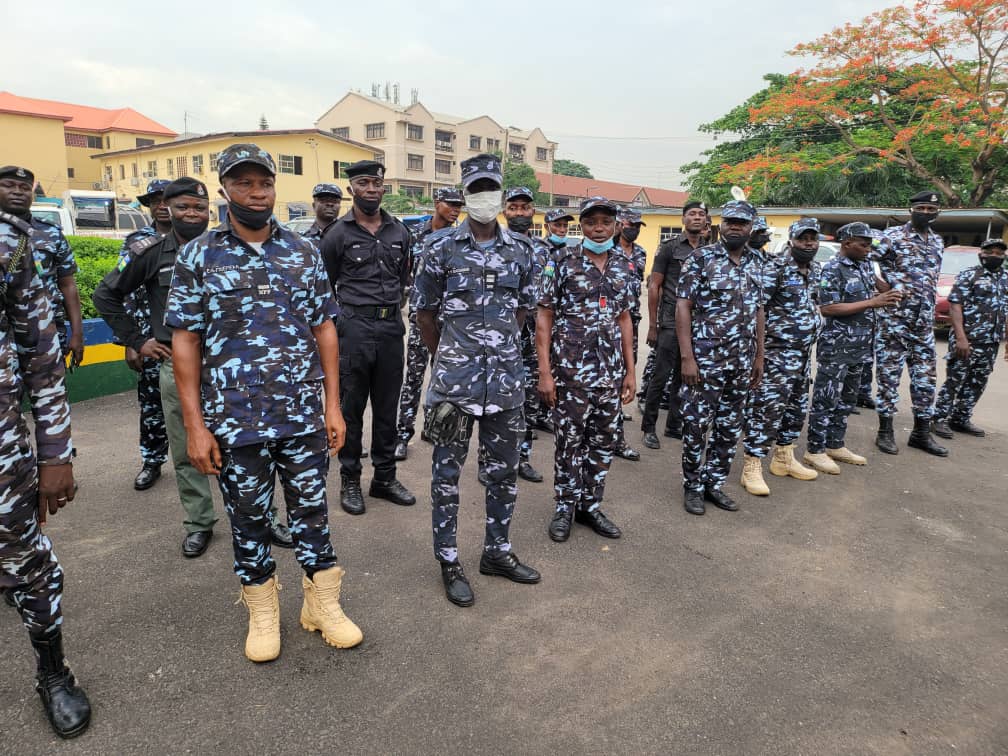
The contemporary LASTMA Officer is expected to possess more than the traditional tools of traffic direction. He must understand crisis management, emotional intelligence, communication, ethical conduct, human-rights principles and the psychology of road users.
This represents a subtle but profound transformation in institutional identity.
The Officer is no longer viewed merely as an enforcer standing between motorists and traffic regulations, but as an ambassador of government, custodian of public safety and first responder in moments of crisis.
Every encounter with a member of the public therefore becomes an opportunity to either strengthen or diminish confidence in government.
From manual enforcement to intelligent mobility
Perhaps the most visible dimension of the Bakare-Oki reforms is the growing incorporation of technology into LASTMA’s operations.
Surveillance cameras, drones, TMS devices, patrol vehicles, body-worn cameras, intelligent communication systems and command-and-control mechanisms are progressively transforming the Agency’s operational landscape.
Furthermore, the newly inaugurated LASTMA toll-free short code, 3367, has, in no small measure, revolutionised the Agency’s feedback architecture, providing the management with a direct and responsive channel for receiving real-time public input, complaints and commendations. Beyond strengthening institutional accountability, the initiative has also contributed significantly to reshaping the behavioural disposition of officers on the roads, reinforcing professionalism, civility and a heightened sense of responsibility in their interactions with members of the public.
The significance of this technological evolution extends beyond modernisation for its own sake. It represents a movement from reaction to anticipation, from manual observation to intelligence-led intervention and from isolated enforcement to coordinated traffic management.
In a megacity where traffic conditions can deteriorate within minutes, the ability to detect emerging incidents, mobilise personnel rapidly and deploy resources strategically is indispensable.
Technology, in this context, becomes not merely an operational tool but an instrument for saving time, preventing secondary incidents and ultimately, protecting lives.
Beyond statistics
The true measure of traffic management, however, is ultimately human.
Behind every accident attended to is a victim whose future may depend upon the speed of intervention. Behind every obstruction removed is a road corridor restored to productive use. Behind every stranded motorist assisted is a potential traffic crisis averted.
LASTMA’s reported 2024 intervention figures—including 1,075 lives rescued, 2,051 crashes involving 3,754 vehicles attended to and more than 5,100 vehicular breakdowns addressed illustrate the magnitude of the Agency’s responsibility.
Yet the most important statistic is the one that cannot adequately be captured on paper: the number of families spared irreversible loss because intervention came in time.
This humanitarian dimension is central to the emerging philosophy of the Bakare-Oki administration.
Accountability
For an enforcement institution, professionalism without accountability is inherently fragile.
The traffic officer possesses considerable discretionary authority, and that authority must be tempered by integrity, discipline and respect for the citizen.
Bakare-Oki has consequently maintained a firm position against corruption and professional misconduct. The strengthening of supervisory and disciplinary mechanisms reflects an understanding that the reputation of an institution is often determined by the conduct of its individual representatives.
The philosophy is straightforward: integrity must not merely be proclaimed; it must be institutionalised.
Collaboration
Bakare-Oki’s vision also extends beyond the physical road.
Traffic management is intrinsically collaborative. It intersects with policing, emergency services, transportation unions, community leadership, infrastructure agencies and the media.
His administration’s engagement with these stakeholders reflects an appreciation that sustainable traffic management cannot be achieved through enforcement alone.
The LASTMA Media Mayors initiative, in particular, demonstrates the strategic value attached to public enlightenment and informed communication. By encouraging journalists to become knowledgeable stakeholders in traffic management, the Agency is strengthening the bridge between institutional responsibility and public understanding.
Legacy
Ultimately, every public servant faces an unavoidable question: What will remain when the office is gone?
A transient administrator leaves behind memories. A transformative leader leaves behind systems.
The enduring significance of Bakare-Oki’s tenure will therefore be determined by whether the culture of professionalism survives him; whether technological innovation becomes permanently embedded in LASTMA’s operational DNA; whether accountability remains non-negotiable; whether emergency response continues to evolve; and whether the relationship between the Agency and the public becomes increasingly founded upon trust and mutual respect.
If these ideals endure, his achievement will transcend the ordinary parameters of administrative success.
He will have helped create institutional memory in motion a LASTMA whose competence has been deepened, whose systems have been modernised, whose personnel have been professionally elevated and whose public-service ethos has been recalibrated.
For Lagos, where mobility is inseparable from economic prosperity, every efficiently managed corridor represents productive time recovered; every emergency swiftly attended to represents a life potentially preserved; and every professionally equipped officer represents a more credible interface between government and citizen.
That is why the Bakare-Oki story is ultimately bigger than traffic.
It is a story about institution-building.
It is about transforming an Agency from merely responding to the problems of today’s roads to preparing for the mobility realities of tomorrow.
And if history eventually records his tenure not simply by the roads cleared or violations enforced, but by the professionalism cultivated, technology institutionalised, lives protected and public confidence strengthened, then Olalekan Bakare-Oki will have achieved something rare in public administration.