

… Corps Marshal, Iyaloja-General receive boost
By Bose Adelaja
CITIZENS COMPASS— The Permanent Secretary of the Office of Environmental Services (OES), Ministry of the Environment and Water Resources in Lagos State, Mr. Gaji Omobolaji Tajudeen, on Tuesday, stated that the State Government would implement policies to make Lagos safer and more secure.
Tajudeen lauded the efforts of the the Lagos Environmental Sanitation Corps (LAGESC), popularly known as KAI, under the leadership of Corps Marshal Major Olatunbosun Olaniyi Cole (Rtd), has been enforcing environmental sanitation laws across the State.
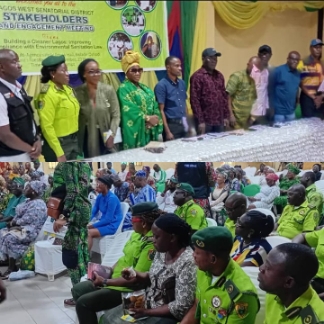
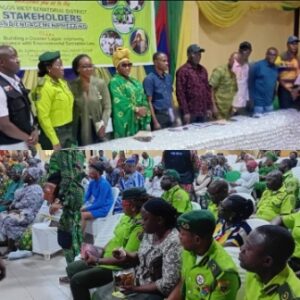
He was the Guest Speaker at the LAGESC Lagos West Senatorial District Divisional Stakeholders’ and Community Engagement
Stakeholders’ meeting for Year 2025 held at the Multi-Agency Safety Arena Hall, Bolade-Oshodi area of Lagos.
The meeting with the theme, ‘‘Building a Cleaner Lagos: Improving Compliance with
Environmental Sanitation Laws’’ was in line with the current State Government’s policy to get rid of street trading and environmental infractions in the metropolis, which will foster a cleaner, healthier, and sustainable environment for the well-being of the citizenry in the State, as epitomized in the THEMES+ agenda.
Citizens Compass reported that the Agency has adopted methods of enforcing State laws via advocacy and collaboration
with relevant stakeholders such as market men and women leaders, Community Development Associations(CDAs), Community Development Committees (CDCs), National Union of Road Transport Workers (NURTW), with the aim to ensure voluntary compliance.
The Lagos West senatorial district in Lagos State, Nigeria covers the local government areas of Agege, Ajeromi-Ifelodun, Alimosho, Amuwo-Odofin, Badagry, Ifako-Ijaiye, Ikeja, Mushin, Ojo, and Oshodi-Isolo.
The Commissioner said the engagement provides the gathering with an opportunity to reflect, reassess, and recommit ourselves to the shared responsibility of building a cleaner, safer, and more compliant Lagos.
According to him, Lagos is a rapidly growing megacity and the commercial heartbeat of Nigeria, with its vibrancy powered by both the formal and informal sectors. However, this growth comes with significant environmental pressures, making strict adherence to sanitation laws not just desirable, but absolutely necessary. The environment of Lagos remains vulnerable to various infractions, ranging from indiscriminate waste disposal and illegal trading activities to encroachment on drainage channels and non-compliance with waste management regulations.
“Under the visionary leadership of Mr. Governor, Mr. Babajide Olusola Sanwo-Olu, the Ministry of the Environment and Water Resources has been mandated to ensure that Lagos remains clean, resilient, and habitable for residents, investors, and visitors alike. This mandate continues to guide our policies, enforcement strategies, and community engagement initiatives.”
Lauding the Corps Marshal, he said, “The Lagos Environmental Sanitation Corps (LAGESC), popularly known as KAI, has remained a frontline agency in enforcing environmental sanitation laws across the State. “Through sustained advocacy, monitoring, and enforcement operations, the Corps has continued to promote orderliness, cleanliness, and public safety in our environment. The visibility of KAI’s operations, both on the streets and across digital platforms, has further strengthened public awareness of environmental responsibilities. I must commend the Corps Marshal, Major Olatunbosun Olaniyi Cole (Rtd.), and his team for their leadership, professionalism, and responsiveness to public concerns.”
While explaining the theme, the Commissioner said, “The theme of today’s engagement, “Building a Cleaner Lagos: Improving Compliance with Environmental Sanitation Laws,” speaks directly to the heart of our collective responsibility. A cleaner Lagos cannot be achieved by enforcement alone; it requires voluntary compliance, behavioural change, and sustained collaboration between government and the governed. Stakeholder engagement remains a powerful tool for fostering ownership, encouraging feedback, and co-creating solutions that are practical, inclusive, and sustainable.
“Across the State, enforcement efforts continue to address critical issues such as illegal street trading, hawking in traffic, obstruction of walkways, and disregard for pedestrian bridges. These actions are not punitive in isolation but are aimed at safeguarding lives, maintaining order, and reinforcing respect for environmental and public safety laws. Consistent enforcement sends a clear message that compliance is non-negotiable.
You will recall that the Ministry has taken decisive steps in tackling perennial flooding by removing structures illegally built on drainage channels and canals. These actions were necessary to restore natural water flow and protect lives and property. We remain resolute in identifying and addressing similar infractions across the State as part of our broader climate resilience and flood mitigation strategy.
“In line with our commitment to environmental protection and public health, the State Government sustained the ban on Styrofoam food containers, a policy that has significantly reduced environmental pollution and protected residents from hazardous materials. Styrofoam’s non-biodegradable nature and its tendency to clog drains during rainfall made this decision imperative for a cleaner Lagos.
“Furthermore, Lagos State continues to champion innovative waste management solutions. The Waste-to-Energy initiative at the Epe landfill, developed in partnership with international investors, underscores our commitment to transforming waste into wealth—reducing landfill pressure, generating clean energy, and creating employment opportunities for our people.
“While the government continues to play its role, it is essential to emphasize that environmental sustainability begins with individual responsibility. Residents are encouraged to maintain cleanliness in their homes, offices, markets, and public spaces, patronize approved Private Sector Participation (PSP) operators, and ensure prompt payment of waste service charges. Where service gaps exist, citizens are encouraged to engage the Ministry, as feedback remains a vital component of service improvement.”
Synergy
“The synergy among environmental agencies such as KAI, Lagos State Waste Management Agency (LAWMA), The Lagos State Environmental Protection Agency (LASEPA), and Lagos State Parks and Gardens Agency (LASPARK) remains a strength of our environmental governance framework. This collaborative approach to enforcement and advocacy must be sustained and strengthened to achieve greater impact.
“I also wish to acknowledge the vital role of market leaders, particularly the market men and women under the leadership of the Iyaloja-General of Lagos State, Chief (Mrs.) Folashade Tinubu-Ojo. Our markets are hubs of economic activity, and maintaining high standards of hygiene within them is crucial to preventing public health challenges such as cholera and other communicable diseases. Market leadership and local government sanitation officers must continue to complement the efforts of the State.
“As we engage today, I am confident that our discussions will yield practical recommendations and renewed commitment toward promoting voluntary compliance with environmental sanitation laws. Together, through shared responsibility, consistent enforcement, and sustained community engagement, we can build the cleaner Lagos we all desire.”
In his welcome speech, the Corps Marshal, Major Olaniyi Olatunbosun Cole (Rtd), LAGESC, was the Agency charged with the responsibility of enforcing environmental sanitation laws and ensuring that Lagos remains clean, safe, orderly, and conducive for living and business.
Cole said of the event, “This engagement forms part of our continuous efforts to strengthen collaboration, deepen community ownership, and consolidate on existing discussions aimed at reducing environmental infractions across Lagos State. It aligns with the vision of Mr. Governor, Babajide Olusola Sanwo-Olu, as articulated in the THEMES+ Agenda, particularly the commitment to making Lagos habitable, resilient, and attractive for business.
“At LAGESC, we firmly believe that environmental sanitation is not the sole responsibility of the government. It is a shared obligation that requires the active participation of community leaders, traders, transport operators, residents, and all stakeholders present here today.
The theme guiding today’s engagement is “Building a Cleaner Lagos: Improving Compliance with Environmental Sanitation Laws.” This theme reflects our collective resolve to strengthen adherence to environmental regulations through awareness, cooperation, and responsible civic behaviour. Compliance, when embraced by communities, reduces the need for enforcement and promotes sustainable environmental orderliness.
“Throughout the year 2025, LAGESC intensified enforcement operations across major highways, inner roads, markets, pedestrian bridges, and public spaces. These operations targeted street trading, illegal dumping of refuse, abuse of road setbacks, medians, drainage channels, and the unlawful occupation of pedestrian bridges.
“We also sustained the enforcement of the ban on Styrofoam food containers, which remain a major contributor to blocked drainage systems and flooding. Given their non-biodegradable and non-recyclable nature, Styrofoam products pose serious environmental and health risks. We therefore encourage the use of environmentally friendly alternatives.”
Mandate
“In furtherance of our mandate, thousands of offenders were apprehended and prosecuted in accordance with the law. These actions are corrective, not punitive, and are aimed at instilling discipline, safeguarding public spaces, and improving compliance.
“However, enforcement alone cannot achieve our desired results.
“To truly build a cleaner Lagos that is habitable for business and safe for residents, we must all adopt positive environmental practices. These include proper waste disposal through approved PSP operators, prompt payment of waste bills, recycling, routine environmental sanitation, and collective vigilance against environmental abuse.
Communities remain vital drivers of compliance. Through advocacy, sensitisation programmes, community clean-up exercises, and the education of our children on hygiene and cleanliness, we can entrench a culture of environmental responsibility that outlives enforcement.”
Collaboration
“Collaboration remains essential. By strengthening partnerships with local governments, traditional institutions, market leaders, transport unions, civil society organisations, and the private sector, we can pool resources, share intelligence, and address environmental challenges more effectively.
“As we approach the new year, I urge all stakeholders to continue supporting the State’s smart waste management initiatives and to promptly report environmental infractions for swift response and corrective action.
“In conclusion, building a cleaner Lagos requires collective commitment and improved compliance with environmental sanitation laws. Every lawful action taken by residents contributes to the safety, health, and prosperity of our State.
Together, let us protect our environment and secure a sustainable future for Lagos.”
Participants all expressed their views in line with the theme.